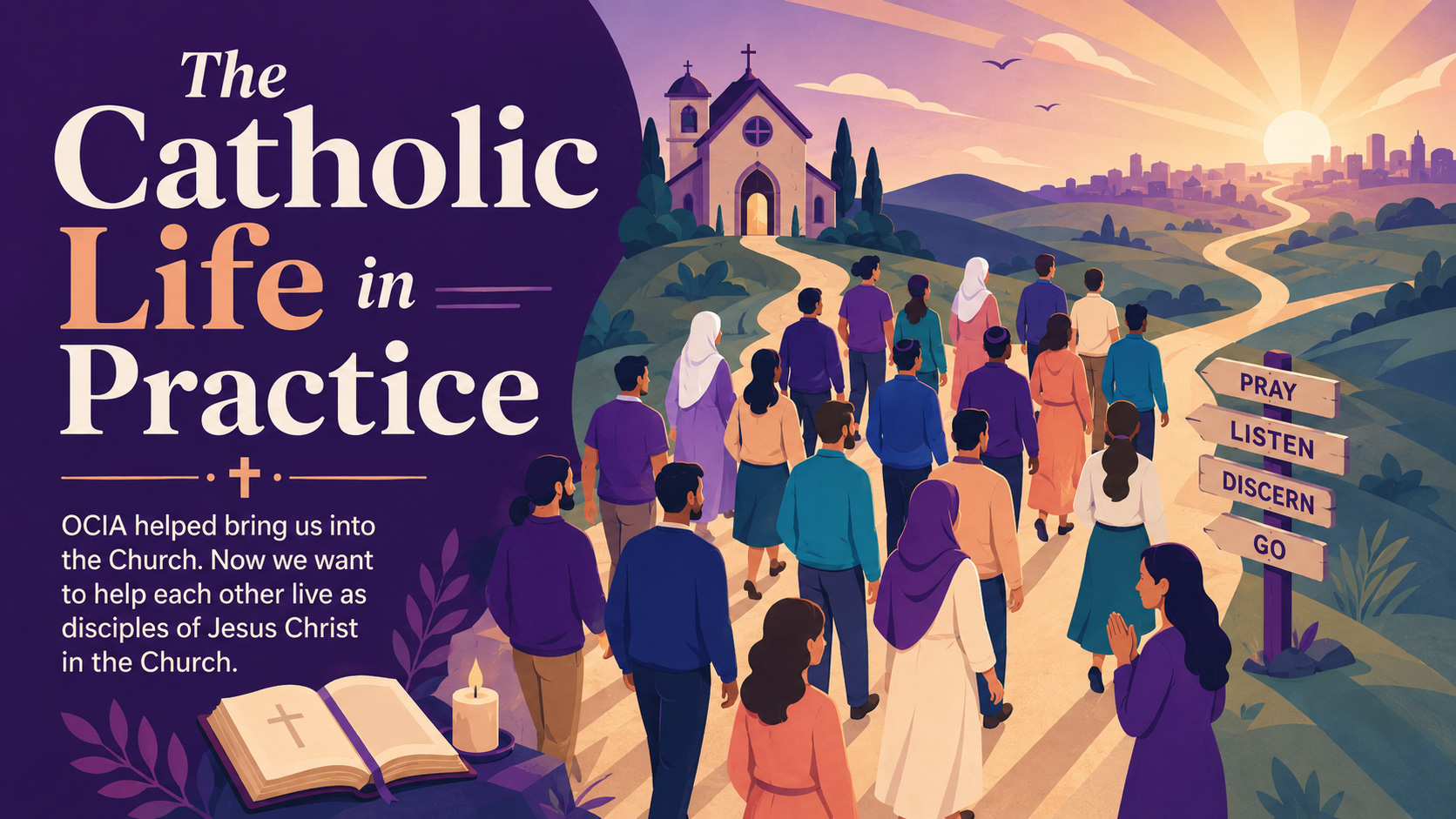
An Invitation
From learning Catholicism to living it.
This is not a Bible study in the academic sense, and it is not OCIA review. It is a small Catholic discipleship community — a place to keep walking together after Easter Vigil and learn what the Christian life actually looks like in marriages, workplaces, parishes, and ordinary Tuesday afternoons. Over fourteen weeks, we move from foundation to formation to mission. Each week, three things happen.
Encounter
We meet Christ in Scripture.
Examine
We look honestly at one area of our real lives.
Obey
We each choose one concrete act for the week.
The Arc
Four movements across fourteen weeks.
The arc moves from foundation to formation to mission. Each week stands on its own — miss one and you’re not behind — but the shape of the whole is intentional. We begin in the Sermon on the Mount and end in the Great Commission.
Foundations
The shape of the disciple’s life and the heart of Christ.
The Catholic Heart
The engine of Catholic life: Eucharist, Confession, daily prayer, the communion of saints.
The Catholic Life
The places real life happens: home, work, money, speech, anger, temptation, suffering.
Sent
Living mercy and going where Christ sends us.
The Curriculum
All fourteen weeks, in detail.
Foundations
i The Disciple’s Life: From Learning to Living +
Before we meet
Read both passages slowly. Sit with this question: What changed in me through OCIA, and what is Jesus inviting me to next?
Discussion
- What surprised you most about becoming Catholic?
- Where does your real life feel furthest from your faith?
- What does “being a disciple” mean to you now, after OCIA?
- What are you hoping for from this group? What are you afraid of?
Concrete act of obedience
Pick one daily moment (morning, midday, or evening). Consecrate it to Jesus this week with one sentence: “Jesus, I am Yours today.” Don’t miss a day.
ii The Beatitudes: The Portrait of Christ +
Before we meet
Read the Beatitudes three times: Which do I understand least? Which do I most resist? Which is Jesus inviting me into right now?
Discussion
- Which Beatitude do you most need right now?
- How does Jesus redefine happiness?
- Where in your life do you seek comfort instead of holiness?
- What would it cost to live one Beatitude this week?
Concrete act of obedience
Pick one Beatitude and live it intentionally — show mercy to one person who irritates you, or make one phone call you have been avoiding.
The Catholic Heart
iii The Eucharist: Source and Summit +
Before we meet
Read the Bread of Life Discourse (John 6) slowly. Notice that many disciples leave over this teaching — and Jesus does not soften it.
Discussion
- When have you most powerfully sensed Christ in the Eucharist?
- What gets in the way of receiving Communion well?
- What would change if we truly believed Christ is in the tabernacle at our parish right now?
- How could we prepare for Mass during the week, not just minutes before?
Concrete act of obedience
This week: arrive five minutes early to Mass to pray. Linger five minutes after to give thanks. Visit the Blessed Sacrament once outside of Mass — even briefly.
iv Confession: The Sacrament of Mercy +
Before we meet
Read the Parable of the Prodigal Son. Pay attention to the father — running, kissing, throwing the feast.
Discussion
- What do you find hardest about Confession?
- What’s the difference between feeling guilty and being convicted?
- Why might “I don’t have any big sins” actually be a spiritual problem?
- How could regular Confession reshape your relationship with Jesus?
Concrete act of obedience
Go to Confession this month. Before you leave, schedule the next one — put it on the calendar.
v A Daily Rule of Prayer +
A simple Catholic rule of prayer
- Morning: Morning Offering — about 1 minute
- Midday: A decade of the Rosary or 10 minutes of Lectio Divina — 10 to 15 minutes
- Evening: The Examen — review the day with Jesus — 5 to 10 minutes
Discussion
- What does your prayer life actually look like right now?
- What gets in the way?
- Which Catholic prayer form draws you most?
- What would a sustainable daily rule look like for your life and schedule?
Concrete act of obedience
Choose one morning practice and one evening practice. Do them every day this week, even if briefly. Don’t aim high. Aim faithful.
vi Mary and the Saints: Our Family in Heaven +
Discussion
- What is your honest experience with Marian devotion so far?
- Is there a saint who has caught your attention? Why?
- How does the communion of saints change how we think about prayer, loneliness, and death?
- What would it mean to live with a patron — a saint you know, learn from, and ask for help?
Concrete act of obedience
Choose one saint. Read about their life this week. Ask their intercession daily. Pray a Rosary — or even just a decade a day — through the week.
The Catholic Life
vii Marriage, Family, and Friendship +
Discussion
- How does the world distort love?
- What is the difference between using someone and loving someone?
- Where do you need to become more faithful in a relationship?
- How can family life — even with all its mess — become a path to holiness?
Concrete act of obedience
Choose one relationship. Do one hidden act of love or repair this week. No announcement. Just do it.
viii Work as Vocation +
Discussion
- What makes work spiritually fruitful?
- Where are you tempted to make work your identity?
- How can you bring Christ into your workplace without being fake or forceful?
- What would St. Joseph teach us about hidden faithfulness?
Concrete act of obedience
Do one ordinary work task this week with unusual care. Offer it to Jesus before you begin. Tell no one.
ix Money, Simplicity, and Trust +
Discussion
- What makes money spiritually dangerous?
- Where do you confuse security with control?
- How does financial anxiety reveal what you are attached to?
- What does simplicity look like for your household?
Concrete act of obedience
Give something away this week. Simplify one expense. Or make one hidden act of generosity without announcing it.
x Speech, Truth, and the Tongue +
Discussion
- Why is gossip so easy?
- What kinds of speech wound community?
- When is silence holy, and when is silence cowardice?
- How can we speak hard truths without cruelty?
Concrete act of obedience
Fast from gossip for one week. When tempted, pray for the person instead.
xi Anger, Forgiveness, and Reconciliation +
Discussion
- What is the difference between forgiveness and pretending nothing happened?
- Why do we sometimes cling to anger?
- What does Jesus show us from the Cross about handling wounds?
- Where might reconciliation be possible — and where might it require careful boundaries?
Concrete act of obedience
Pray daily for someone who has wounded you. If appropriate and safe, make one step toward peace.
xii Temptation and Spiritual Warfare +
Discussion
- What temptation returns most often in your life?
- What patterns make you vulnerable?
- How did Jesus respond in the desert?
- What practical protections do you need this season?
Concrete act of obedience
Remove one near occasion of sin this week. Replace it with prayer, Scripture, or a phone call to someone trustworthy.
xiii Suffering and the Cross +
Before we meet
Where in your life are you carrying something — illness, grief, betrayal, a hard relationship, a hidden fear? Bring it gently to prayer this week, not for answers, but to be with Jesus in it.
Discussion
- What suffering are you carrying right now?
- What do you do with it — distract, numb, complain, offer it?
- How does Jesus’ agony in the garden change how we approach our own?
- What does it mean to “offer it up,” practically?
Concrete act of obedience
This week, when something hard happens — irritation, pain, disappointment, even a small inconvenience — pause and say, “Jesus, I offer this to You for [someone you love].”
Sent
xiv Mercy in Action and Mission +
Before we meet
Write a short answer to two questions: Where is Jesus sending me? What has changed in me over these fourteen weeks?
Discussion
- What has changed in you over these fourteen weeks?
- Where is Jesus asking you to be more courageous?
- Who in your life needs the love and truth of Christ?
- What is one shared mission this group could carry forward?
Concrete act of obedience
Each person names one mission commitment for the next 30 days. The group decides together on one shared work of mercy to begin.
The Meeting
How a Tuesday actually flows.
Seventy-five to ninety minutes. Six movements. No homework, no quiz. The spiritual heart is this: each person leaves with one thing to live, not just one thing to remember.
Welcome & Opening Prayer
A short prayer to the Holy Spirit.
Scripture
Read slowly. Sometimes twice. Thirty seconds of silence after.
Leader Reflection
Lance connects the topic to Jesus in the Gospel. Bobbi Jo connects it to ordinary Catholic life.
Group Discussion
Three to five questions. Quiet voices drawn in gently. No fixing.
Act of Obedience
Each person chooses one small, concrete action for the week.
Intentions & Closing
Place the group before Jesus.
“Tonight we are not trying to master this topic. We are asking: where is Jesus inviting us to conversion?”
The Covenant
Seven things we agree on together.
Read aloud at the first meeting and revisited as needed. These are not legalisms — they are how we protect a real conversation about a real life with the real Christ.
- Christ stays at the center. We are not here to win arguments or show what we know.
- Speak from your own life. Use “I” more than “people should.”
- No fixing or preaching at one another. We can encourage, but we are not each other’s spiritual directors.
- Confidentiality. What is shared here stays here, unless someone is in danger.
- The Church teaches with authority. When moral or doctrinal questions arise, the group does not vote on truth. We look up what the Church teaches and return to it.
- One act of obedience each week. Small, concrete, doable.
- Attendance matters. Life happens, but this is not drop-in. Tell the group when you can’t make it.
The Leaders
Two voices, one conversation.
Each week the reflection is divided. The combination keeps the group both Christ-centered and grounded in ordinary life.
Lance
Connects the topic to Jesus in the Gospel — what is He revealing, demanding, offering? Where does this text show us who Christ is?
Bobbi Jo
Connects the topic to ordinary Catholic life — home, marriage, family, friendship, work, prayer. What does this look like Monday morning?
Between Tuesdays
The other one hundred and sixty-seven hours.
The meeting is one hour of the week. The rest is where formation actually happens. Here is the rhythm that holds the group together between Tuesdays.
The pre-meeting note
Scripture, a short reflection from Lance or Bobbi Jo, a Catechism paragraph, a saint to pray with, and one question to carry into prayer. No pressure to prepare deeply — but come prayerfully.
The meeting itself
Seventy-five to ninety minutes. Six movements. One concrete act chosen for the week.
The recap
A short note: what we talked about, the group’s prayer intentions, one optional resource for going deeper. Your act of obedience stays between you and Jesus — we’ll ask how it went on Tuesday.
One question to the group text
“How is Jesus meeting you this week?” Respond or don’t. No pressure. Lance and Bobbi Jo model brief, honest answers.
Accountability pairs
Same-sex pairs (men with men, women with women), one short conversation per week — phone, coffee, or text — about how the act of obedience is landing. This is where the deepest growth happens.
Resources
Take it with you.
The full curriculum, leader notes, and weekly handouts — ready to print, share with your pastor, or carry to next Tuesday’s meeting.
Mission flows from fidelity. We do not save the world. Christ does. We cooperate.
A guiding word for the journey